
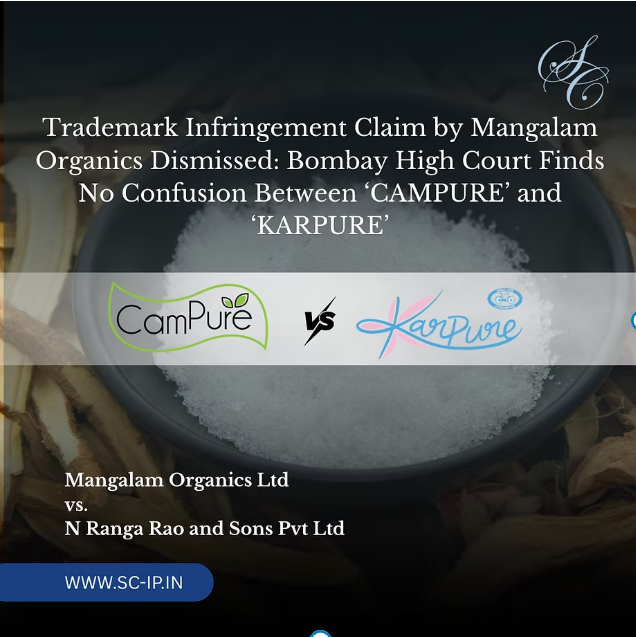
In a recent trademark dispute, the Bombay High Court dismissed the plaintiff, Mangalam Organics Ltd.’s (“Plaintiff”) interim injunction application against the use of the marks “KARPURE” and “AIR KARPURE” by N Ranga Rao and Sons Pvt. Ltd. (“Defendant”), citing no actionable case of trademark infringement or passing off.
Plaintiff claimed that the Defendant’s use of the marks “KARPURE” and “AIR KARPURE” infringed its registered mark CAMPURE and CAMPURE Device, which it used for camphor-based products since 2017. The Plaintiff claimed that it has built substantial goodwill and reputation in the CAMPURE marks, supported by considerable sales and advertising expenditure. In 2022, Plaintiff found that Defendant intends to launch camphor-based products under the marks “KARPURE” and “AIR KARPURE” with similar trade dress. It was further submitted that the suffix “PURE” was distinctive in connection with camphor products and had come to be exclusively associated with the Plaintiff. The Plaintiff also emphasized that under the Trade Marks Act, 1999, passing off actions were maintainable even against registered proprietors.
The Defendant argued that, as the registered proprietor of its marks, the Plaintiff cannot claim infringement. The Defendant also claimed that rival marks were phonetically and visually dissimilar. Further, the Defendant uses the letter K as a distinctive element and has added the word AIR in its mark. It also argued that the word PURE is a common descriptive term in the trade and that no one could claim a monopoly over it. The Defendant also claimed acquiescence since the Plaintiff, despite sending a cease and desist notice in 2022, filed a case in 2025.
The Court held that trademark infringement under Section 29 of the Trade Marks Act, 1999, does not apply when both parties hold valid registrations. Further, the court opined that since the Plaintiff did not oppose the Defendant’s registration earlier, and both marks passed legal scrutiny, infringement was not established. The Court found no phonetic or visual similarity between the marks KARPURE and CAMPURE, emphasizing distinct packaging and no likelihood of consumer confusion. The passing off claim also failed due to a lack of specific misrepresentation and the absence of consumer confusion. The Court also emphasized the importance of full disclosure since the Plaintiff hid opposition against its CAMPURE mark by a third-party CALAPURE mark, where it argued that CALPURE and CAMPURE marks are different and dismissed the interim relief, affirming that registered trademarks can coexist. Mangalam Organics Ltd v. N Ranga Rao and Sons Pvt Ltd, 2025 SCC OnLine Bom 301 Read the judgement copy here.